3 Flexibility Tools to Boost Your Post-Workout Recovery
Could your flexibility use a boost? Want to recover faster from workouts? Looking to soothe tired or sore muscles with something other than a foam roller? Then this post is for you! We recently tried three flexibility tools that can help you do all that. Yes, they may hurt a little, but it’s the good kind of hurt. Promise.
3 Flexibility Tools to Try
1. Gaiam Restore Multi-Grip Stretch Strap. Ever been in a yoga class where the instructor is telling you to deepen a stretching pose that — ahem — you can’t even get into, let alone go deeper in? Yeah, I’ve been there. And while those straps they give you in yoga are awesome, this Multi-Grip Stretch Strap is even more helpful. For less than $15, this handy dandy flexibility tool allows you to progress through different grip positions with no slipping. Use it daily to help you stretch out tight muscles, prevent injury and improve your range of motion!
2. Gaiam Restore Hot/Cold Trigger Point Massage Ball. I also like to call this one “little evil ball of pain.” Because, well, it’s painful — and targeted. But, like a foam roller, it hurts so good. Designed to release muscle tension in hard to reach places like your back or piriformis, this little ball stimulates blood flow while massaging sore, tired muscles with its little nubs. To further boost your post-workout recovery, you can even heat the ball in warm water or freeze it in the freezer for hot or cold relief that lasts up to 30 minutes. At $14.99, it’s kind of like a foam roller, but just waaay more advanced and intense. A great flexibility tool!
3. Gaiam Restore Hot/Cold Foot Massage Roller. I love foot rubs. And I’m lucky in that my husband will rub my feet after long runs. But for times when he’s not home or I’m being a total foot-rub need-beast, I love the Gaiam Restore’s Hot/Cold Foot Roller. For about $15, you simply roll your foot over it for a kneading effect that gives extra relief from tightness, heel spurs and plantar fasciitis. And like the massage ball, you can also heat it up or cool it down for an even more therapeutic foot-rolling session. Oh, and it feels pretty awesome.
On a personal note, I’ve been loving all of these flexibility tools because they’re each helping me to stay injury free and improve my range of motion, as per my New Year’s resolutions! What’s your favorite way to boost your flexibility? —Jenn
Original article and pictures take fitbottomedgirls.com site
You want to take your training to the next level? Then you’re going to need to start working on your flexibility. That doesn’t mean simply doing a post workout stretch! If you do a post-workout stretch, you are one step ahead of most, but that’s not going to give you a greater range of motion. If you want to be more agile, or you want to be stronger, you need to do MORE than just stretch.
I’m lucky that I’ve been involved in sports and activities that require flexibility my whole life. Some people are lucky as far as their genetics, but even if you’re not lucky you can still be more flexible than you are today if you work at it.
I grew up as a competitive gymnast. In an effort to pursue a career in acting and stunts, I replied to an audition notice for the circus and fell in love with live entertainment. I worked and trained with The Underground Circus in Vancouver for three and a half years, studied dance to improve my performing abilities, and later moved to Australia for three years to study circus where I specialized in hand balancing. While in Australia, I created a class devoted to increasing peoples’ range of motion. It is a class I wished existed for years, and I took it upon myself to share it with the world. I’ve been teaching these classes in Melbourne, Vancouver, and now in Montreal.
One of the reasons that circus performers are able to do such high level amazing feats is because they train all elements of athleticism. Typically, circus performers will train strength, flexibility, hand stands, basic acrobatics, physical performance, and then they will spend 5-10 hours per week training their specialty on top of that!
Everyone has excuses, but there are solutions. Here are the top three excuses I get for why people don’t work on their flexibility:
Flexibility Excuse #1: It Hurts
Does it hurt when you train hard? Do your muscles get sore and burn? So, why can you put up with that pain but you won’t put in the effort to become an all-around athlete?
The main reason that it hurts when athletes who don’t have flexibility training try to work on their flexibility is that they don’t know how to relax. They think that if they tense their muscles and push as hard as they can they will become more flexible; it doesn’t work that way. If you look at a muscle in its tense state it’s hard as a rock. If you try to pull it apart with enough force, all that is going to happen is eventually it’s go- ing to crack. The same thing happens with your muscle if you stretch when it’s tense. A muscle in a relaxed state is more like dough. As you pull it apart it gets longer and longer as though you’re about to make a baguette. This is what we want.
The other reason it hurts is because people tend to hold their breath when they stretch. You need as much oxygen and blood flowing to the muscle; keep it warm and relaxed so that you are able to go deeper into the stretch without injuring yourself.
Flexibility Excuse #2: I Don’t Have Time
Ok, I get it, it does take time; so make time! Just an hour a week of focused flexibility training will really make a difference in your range of motion. Take a good 30 minutes to warm up and do some basic stretching without pushing it too far. After you’re warm, you can take another 20 to 30 minutes to push it that little bit extra.
Flexibility Excuse #3: “I don’t know how to work on my flexibility.”
This is a legitimate excuse. Being able to work on your flexibility with proper technique is important. If you haven’t been taught how to stretch properly, or what stretches to work on, then of course you can’t work on it. The solution is simple: find a trainer! Do you train with a coach for your sport? Do you work with a personal trainer for your strength work? What do you do when you want to learn a new skill to improve yourself as an athlete? You find time and a way to learn it. I highly recommend working with someone to correct your alignment and make sure you’re doing the stretch properly.It also helps to have some one to cue you into the right position when doing some of the more intense stretches where muscle isolation is involved.
Original article and pictures take onnits3.imgix.net site
Everyone’s nutritional requirements are different depending on their goals and daily activities, but this list of 25 of the best pre and post workout snacks can offer the right balance of carbohydrates, fats, and protein to satisfy hunger pangs, fuel your workouts, and aid in muscle recovery. Continue reading for the list!
Pre- Workout Snacks
1. One or two hard boiled eggs with one slice of whole wheat toast
2. 1/2 cup cottage cheese with 1/2 cup fruit, such as pineapple
3. One medium green apple with 2 tbsp natural peanut butter
4. Energy gel- only if you’ve got a seriously long run/workout ahead!
5. 1/2 cup nonfat Greek yogurt with 1/2 cup berries
6. 1 cup variety of fruit
7. 1 cup salad greens, one hard-boiled egg and a drizzle of EVOO or vinegar
8. 2-4 ounces turkey with 1/4 avocado
9. Two whole eggs and 1/2 cooked oatmeal
10. 2-4 ounces of chicken breast with 1/2 cup brown rice
Post- Workout Snacks
11. Chunky Monkey Shakeology: 1 medium banana, 1 tablespoon peanut butter, 1 scoop Chocolate Shakeology and 1 cup low-fat milk blended with ice.
12. Brown rice cake topped with 2 tbsp peanut butter
13. 1 cup low-fat chocolate milk
14. One medium green apple with one stick light string cheese
15. Whole wheat pita topped with 2 tbsp hummus
16. Half a whole wheat bagel topped with two egg whites
17. 1 banana and 1 cup low-fat milk
18. 1 scoop Whey protein, or protein of your choice, mixed with 1 cup low-fat milk or water
19. 2-3 eggs scrambled with veggies
20. One serving high-fiber cereal with low-fat milk
21. Cottage cheese with one slice whole wheat toast
22. Greek yogurt with 1/4 cup granola
23. 4 ounces tuna with one slice whole wheat toast
24. 1/2 cup shelled edamame
25. 15 baby carrots with 2 tbsp hummus
And as always, don’t forget to SUBSCRIBE to receive updates of new posts!!
After hearing hundreds of people tell me that it was too expensive to eat healthy, I became on a MISSION to help show how it can be done on a budget! Get your FREE copy now!
Original article and pictures take whitneydelong.com site
Go Technical Beat Boredom Don't Stretch Before Set a Goal Add Strength Training Aim For Midfoot Stay Alert Take Shorter Strides Find a Buddy Original article and pictures take media1.popsugar-assets.com site
17 Stretches You Need for When Your Body Can't Even
Sometimes your body just can't catch a break. So get some sweet relief with these stretches from Cassey Ho, YouTube fitness star and founder of 24-Hour Fitness's Popilates fitness class.
After Spending a Million Hours at Your Computer
Your wrists and chest are tight AF, but these stretches can help:
Cassey is wearing Sports Bra, MICHI, $85; Jacket, MICHI, $235; Leggings, MICHI, $125; and Sneakers, UNDER ARMOUR, $80.
1. Wrist Twist
Extend both arms out in front of you and make fists with your hands. Rotate your fists in toward each other and continue for as long as you'd like. Then switch directions.
2. Chest Opener
Stand up straight and open your arms out to the sides. Turn your palms to face forward and press them back. Then turn your palms to face backward and repeat. Continue to alternate.
3. Forearm Stretch
Extend both arms out in front of you and turn your left fingertips down with the palm facing away from you. With your right hand, grab the left fingertips and pull them toward your body. Turn your left palm to face the body, then repeat. Repeat the stretch on the opposite side.
Your neck and back are seriously hurting. Iron out the kinks with these stretches:
4. Neck Tilt
Stand up straight and reach your left hand overhead, placing the palm on the right side of the head. Gently pull your head to the left shoulder and hold. Switch sides and repeat.
5. Twisted Triangle
Take a wide stance with feet turned slightly outward and your knees locked. Extend both arms straight out to the sides. Bend from the waist to touch you right fingertips to your right toes. Hold as long as you'd like, then bend to the opposite side.
6. Cat Cow
Get on all fours with your knees under your hips and your wrists under your shoulders. Arch your back, and let your head drop as you tuck your tailbone under (cat). Then let your belly drop and stick your tailbone out as you open your chest and bring your gaze upward (cow). Continue to alternate between cat and cow at your own pace.
Your hips are tight, and your legs and butt are asleep. Get the blood flowing with these stretches:
7. Pigeon
Take a low lunge with your right foot forward, and place both palms on the ground framing your foot. Drop the back knee to the floor. Sweep your right foot through the legs and place the outside of the right calf against the floor, keeping the calf parallel to your hips and hips square to the ground.
8. Long Lunges
Take a large step forward with your right foot and bend only your right knee to come into a low lunge, placing your left palm on the ground for support. Keeping your right knee behind your right toes, gently bend the left knee, hold, then straighten the left leg. Continue to bend and straighten the back leg slowly for as long as you'd like, then switch legs.
9. Hip Opener
Get into a plank position and pike your hips up into downward facing dog position. Keeping your hips square to the ground, bend right knee and stretch your right heel overhead toward your right left shoulder. Hold, then repeat on the opposite side.
After Dancing in Heels All Night
Your calves and hamstrings are killing you.
10. Figure-4 Glutes Stretch
Lie on your back with your arms along your sides, your knees bent, and the soles of your feet on the floor near your butt. Place your left ankle over your right leg, just below the knee. With both hands, grasp your right thigh and bend your elbows to gently pull your right knee in toward your chest. (You should feel it in your left hip.) Repeat on the opposite side.
11. Calf Reach
Lie on your back with your legs outstretched. Keeping them as straight as possible, lift the right leg straight up and point the toe as you reach around your calf with both hands and pull your leg toward your chest. Hold, then switch legs.
12. Calf Stretch
Face a tree (or step or wall) and stand an arms-length away from it. Place your right toes against the trunk with your right heel a few inches from the base. Lock your right knee and bend from the waist, reaching both arms toward the lifted toes. Hold, then repeat on the opposite side.
13. Upward-Facing Dog
Lie face down on a mat with your legs outstretched and tops of your feet pressed against the ground. Place your palms beneath your shoulders and extend the elbows to raise your upper body, lifting your hips off the ground. Lean back to deepen the stretch.
14. Quad Stretch
Stand up straight with knees together and bring your right heel to your butt, using your right hand to grab your right toes. Press the right hip forward to deepen the stretch, keeping your knee pointing downward the whole time. Hold for as long as you'd like, then switch legs.
15. Cross-Body Arm Stretch
Standing up straight, cross your right arm across your chest. Bend your left elbow to bring your left hand toward your shoulder and deepen the stretch in your right triceps. Hold as long as you'd like, then repeat on the opposite side.
16. IT Band Stretch
Lie on your back with your legs outstretched and raise your right leg straight up in the air. Extend your right arm out to the side and place it on the floor as you press your left hand against the outside of your right calf to bring the leg across the body to the left, keeping your left hip grounded. Hold, then repeat on the opposite side.
17. Overhead Triceps Stretch
Bend your left elbow and bring it up beside your head, letting your left hand reach down the back. With your right hand, gently pull the left elbow backward. Hold, then repeat on the opposite side.
Original article and pictures take www.cosmopolitan.com site
17 Stretches Every Man Should Know Photograph by Dylan Coulter - Grooming by Kristan Serafino - Prop Styling by Richie Owings Photograph by Dylan Coulter 1 / 17
Torso Release
Stretches: The arm and torso.
How: Raise your left arm over your head, then bend your elbow so your left hand drops below your head. Place your right hand behind your left elbow and gently pull your left arm over and down. Repeat with opposite arm.
Get more by: Extending your arms out from your sides and doing arm circles in both directions for 20-30 seconds each.
Photograph by Dylan Coulter 2 / 17
Pain Relief: Aching Hamstrings
Stretches: The hamstrings.
How: Standing with your feet two to four feet apart, bend your knees as you lean forward and grab your ankles (or feet). Keeping one hand on each ankle, gently try to straighten your legs.
Get more by: Placing both hands on your left foot, then your right.
Photograph by Dylan Coulter 3 / 17
Pain Relief: Tight Triceps
Stretches: The triceps.
How: Kneel in front of a low, sturdy object (such as a chair), then lean forward and place elbows on top. Tucking your hands behind your head, grab each wrist to help gently bend each arm even further.
Get more by: Pushing the wrist further back or pressing your torso toward the floor.
Photograph by Dylan Coulter 4 / 17
Strained Lower Back Stretch
Stretches: The chest, lower back, and calves.
How: Stand with your left foot forward, feet about three feet apart. Press your fists into your back while pushing your hips forward and raising your chest to the ceiling. Repeat with opposite leg.
Get more by: Planting your back heel.
Photograph by Dylan Coulter 5 / 17
Pain Relief: Pain Between Shoulder Blades
Stretches: The pectoralis minor, which can strain back muscles.
How: Get on all fours alongside a knee-high object. Bend your arm at 90 degrees, and place it on top. Exhale as you gently twist, pressing the shoulder of that arm down toward your opposite hand. Repeat with other arm.
Original article and pictures take www.mensjournal.com site
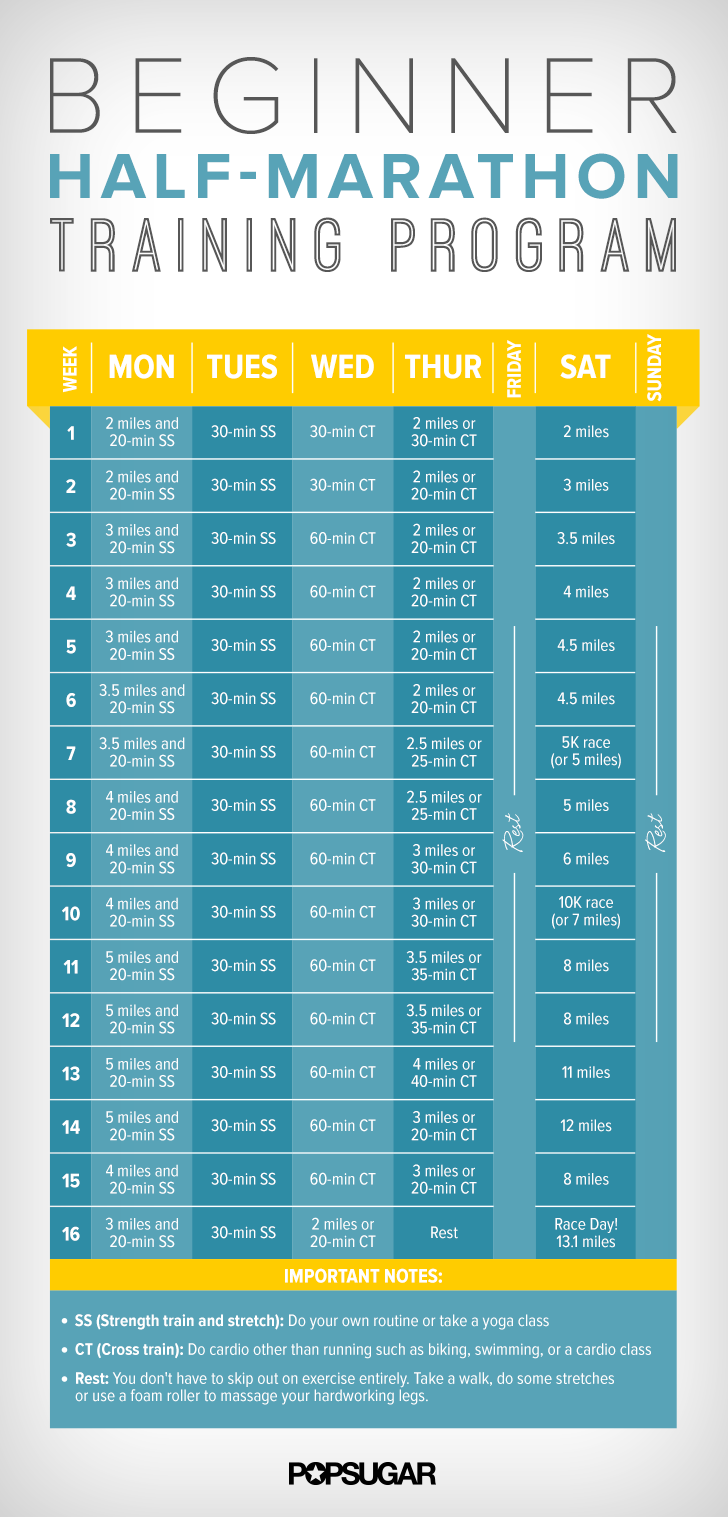
16-Week Half-Marathon Training Schedule For Beginners
If you have a few 5Ks and 10Ks under your belt, you're probably thinking about running your first half marathon. Doubling your racing distance means building endurance by increasing your weekly mileage. Don't be daunted by this! Try this 16-week training schedule that adds miles safely. There are cross-training, strength-training and stretching, and rest days built into the program to help prevent injury. Plus, the long runs are on Saturdays when you have time to go the distance, giving you Sundays to recover.