Upgrade your workout routine with these 10 leg exercises for women. Work your thighs, hips, quads, hamstrings, and calves at home to build shapely legs and get the lean and strong lower body you’ve always wanted!
Repeat this circuit 3 times and rest for 60 seconds between sets.
1. High knees: 60 seconds. Bring your knees up to waist level and then slowly land on the balls of your feet.
2. Curtsy lunge: 30 seconds + 30 seconds. Keep your weight on your right foot, take a big step back with your left leg and cross it behind your right leg. Bend the knees until your right thigh is parallel to the floor and then return to the starting position. Keep your toes pointing in the same direction as your knees.
3. Inner thigh lifts: 30 seconds + 30 seconds. Lie on your side, cross your top leg over and lengthen your bottom leg. Flex your bottom foot and press that leg up and down for 30 seconds.
4. Squat jacks: 45 seconds. Jump up, spread your feet, bend your knees and press your hips back. Push through the heels to jump back up and return to the starting position.
5. Bear squat: 45 seconds. Get down on your hands and knees, straighten your legs and lift your hips up toward the ceiling. Return to the initial position and repeat.
6. Bulgarian split squat: 30 seconds + 30 seconds. Place a step or a box behind you and stand up tall. Place your right foot on top of the step, bend your knees and lower the hips until your left thigh is parallel to the floor. Return to the starting position, repeat for 30 seconds and switch legs.
7. Skaters: 45 seconds. Lean forward with your back flat, jump to the right, bring your left foot behind you and bring your left arm in front of you. Jump to the left and bring your right arm in front of you and your right foot behind you. Repeat for 45 seconds.
8. Plie squat calf raise: 45 seconds. Start in a sumo squat position, with your feet in a wide stance, your toes pointing out to the sides and your thighs parallel to the floor. Raise your heels off the floor and squeeze your calves. Lower your heels and repeat.
9. Single leg bridge: 30 seconds + 30 seconds. Lie on your back with your arms by your sides, knees bent and feet flat on the floor. Raise one leg and lift your hips as high as you can. Lower your hips, repeat for 30 seconds and switch legs.
10. Wall sit: 45 seconds. Stand with your back pressed against a wall, your knees bent and your thighs parallel to the floor. Hold this position for 45 seconds.
What you eat is important. However, when you eat it can be just as critical.
What is post-workout nutrition?
Post-workout nutrition is an intriguing topic and rightfully so. The basic idea is threefold:
The body deals with nutrients differently at different times, depending on activity.
What you consume before, during, and especially after your workout is important.
By consuming particular nutrients after your workouts (aka post-workout nutrition), you improve your body composition, performance, and overall recovery.
Numerous studies have examined everything from the composition of the carbohydrate in post-workout drinks to exact amino acid combinations. Studies continue to reveal effective post-workout nutrition strategies for athletes and recreational exercisers of all types.
Generally, post-workout nutrition has three specific purposes:
Replenish glycogen
Decrease protein breakdown
Increase protein synthesis
In other words, athletes/exercisers want to:
replenish their energy stores
increase muscle size and/or muscle quality
repair any damage caused by the workout
In doing so, they want to increase performance, improve their appearance, and enable their bodies to remain injury-free.
Proposed benefits of good post-workout nutrition include:
Improved recovery
Less muscle soreness
Increased ability to build muscle
Improved immune function
Improved bone mass
Improved ability to utilize body fat
These benefits seem to work for everyone, regardless of gender or age.
Why are workout and post-workout nutrition so important?
When we work out intensely, we damage tissues at the microlevel, and we use fuel.
This is what ultimately makes us stronger, leaner, fitter, and more muscular, but in the short term it requires repair.
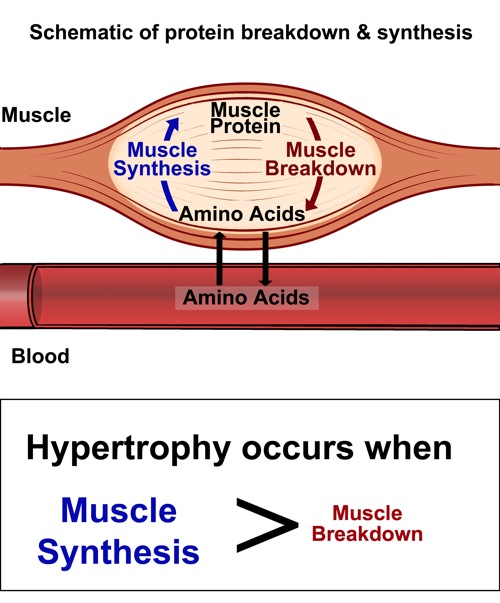
Repair and rebuilding occurs through the breakdown of old, damaged proteins (aka protein breakdown) and the construction of new ones (aka protein synthesis) — a process known collectively as protein turnover.
Muscle protein synthesis is increased slightly (or unchanged) after resistance workouts, while protein breakdown increases dramatically. We’re doing a lot more breaking-down than building-up.
The relationship between these two parameters (rate of muscle protein synthesis and muscle protein breakdown) represents the metabolic basis for muscle growth.
Muscle hypertrophy occurs when a positive protein balance can be established during recovery — in other words, when we make sure we have enough raw materials available for protein synthesis to occur, so that it doesn’t lag behind protein breakdown.
This is especially difficult with endurance athletes as protein synthesis drops and protein breakdown goes up.
Protein breakdown and synthesis
Studies show that this trend can be reversed – specifically, protein synthesis is stimulated and protein breakdown is suppressed when you consume the right type of nutrients after exercise.
Protein is not the only concern, however. During exercise sessions, stored carbohydrates can be substantially depleted.
Thus, during the postworkout period, we require protein and carbohydrates.
The raw materials we give our body through the consumption of food/supplements in the workout and post-workout periods are critical to creating the metabolic environment we desire.
What you should know about workout nutrition
Availability
Availability strongly influences the amino acid/glucose delivery and transport.
In other words, in order for our bodies to use raw materials to rebuild and recover, those raw materials have to be available. And if they’re available, then our body is more likely to use them. Simply having the materials around can signal to our body that it’s time to rebuild.
We improve availability in two ways.
Increased blood flow to skeletal muscle during and after exercise means that more nutrients are floating around more quickly.
Providing an amino acid and glucose dense blood supply during and after exercise means that the rate of protein synthesis goes up.
Thus, we improve availability by having more blood circulating more rapidly, and by having more nutrients in that blood.
The “window of opportunity”
Some refer to this workout and post-workout phenomenon as “the window of opportunity”.
During this window, your muscles are primed to accept nutrients that can stimulate muscle repair, muscle growth, and muscle strength.
This window opens immediately after your workout and starts to close pretty quickly. Research suggests that while protein synthesis persists for at least 48 hours after exercise, it’s most important to get postworkout nutrition immediately, and within 2 hours afterwards.
If you feed your body properly while this window is open, you’ll get the benefits.
If you don’t provide adequate post exercise nutrition fast enough — even if you delay by only a couple of hours — you decrease muscle glycogen storage and protein synthesis.
As soon as you drop that last dumbbell, you should be consuming some postworkout nutrition.
What to eat
As we’ve mentioned, post-workout nutrition requires two things:
Protein to aid in protein synthesis
Carbohydrates to help replace muscle glycogen (and to enhance the role of insulin in transporting nutrients into cells)
You could certainly eat a whole food meal that meets these requirements after exercise.
However, whole food meals aren’t always practical.
Some people aren’t hungry immediately after exercise.
Whole food digests slowly, and we want nutrients to be available quickly.
A whole food meal that requires refrigeration might be less practical.
On the other hand, consuming a liquid form of nutrition that contains rapidly digesting carbohydrates (e.g., maltodextrin, dextrose, glucose, etc) and proteins (e.g., protein hydrolysates or isolates:
might accelerate recovery by utilizing insulin for nutrient transport into cells;
can result in rapid digestion and absorption; and
is often better tolerated during and after workouts.
Combining protein and carbohydrates might aid recovery
Data indicate that it may only take about 20 grams of protein after a workout to maximally stimulate muscle protein synthesis.
Which workouts qualify?
Save your workout drink for weight training, interval, and endurance training lasting 45 minutes or longer.
Casual exercise like walking the dog, moving cobblestones for grandpa, or riding your bike to the arcade doesn’t require a recovery drink.
When performing energy expenditure work to burn energy or lose fat, a recovery drink is not necessary. If you’re prioritizing fat loss, performance and recovery from these sessions are not as important as creating an energy deficit.
Still, if overall energy intake is low from food intake, and lots of time is being spent performing energy expenditure work, consuming a branched chain amino acid (BCAA) supplement might be helpful.
Summary and recommendations
With intense workouts/training, start by ingesting 30 grams of carbohydrate and 15 grams of protein (in 500 ml water) per hour of workout time.
You can sip this during the workout or consume it immediately after.
You can either make your own post-workout drink or find a pre-formulated drink that contains rapidly digesting carbohydrates (e.g., maltodextrin, dextrose, glucose, etc) and proteins (e.g., protein hydrolysates or isolates).
Once your workout is complete, have a whole food meal within an hour or two.
If priority #1 is to lose body fat, use only BCAAs as a workout drink. About 5 to 15 grams per hour of training (200 pounds or more = closer to 15 grams, 200 pounds or less = closer to 5 grams).
If you’re leaner but still want to lose fat, choose a smaller dose (like 1/2 dose) of the protein + carb combination, or opt for BCAAs.
For extra credit
The combination of carbohydrate and amino acids during/after exercise creates a stimulatory effect of growth hormone and testosterone that doesn’t happen during the rest of the day. In other words, if you just drink a carb + protein drink while sitting on the couch, it won’t have the same effect.
When choosing carbohydrates, keep in mind that glucose is absorbed faster than fructose, and solutions high in fructose have been linked to gastrointestinal distress, greater fatigue, and higher cortisol levels.
It may be helpful to add creatine to your workout nutrition.
Essential amino acids may be more important than nonessential for promoting positive nitrogen balance after workouts.
Eat, move, and live… better.
The health and fitness world can sometimes be a confusing place. But it doesn’t have to be.
Active Isolated Stretching (AIS) is a technique that lengthens and strengthens muscle tissue. Our muscles have two major functions: to contract or relax. The idea of AIS is to hold a stretch for one to two seconds, relax, and then repeat the movement for 10 to 15 times for one to two sets. When the stretch is done right, you should be able to increase your range of motion with each additional set.
The benefits of incorporating AIS into your routine are numerous: increased isolated flexibility, realignment of the body, reduced chance of injury and better awareness of your body. Try the following routine four to five times a week after your runs.
Get down on all fours and keep your head in a neutral position. Extend one leg back and focus on contracting your glutes and hamstring. Get into a fetal position; rest your right side on the floor. Keep the left hip and knee directly over the right hip and knee. Sit with your knees bent and your feet out in front of you. Pull your chin down into your chest. Pull your nose towards your belly button, which will allow your spine to flex forward and down. You can pull down on your ankles with your hands to give you some assistance. Hold each stretch for two seconds. Complete one to two sets of eight to 12 reps. Start in a standing position, making sure to hold your core tight. Pull your arms up and back, squeezing your shoulder blades together. Try pulling your arms back in different angles to stretch the entire chest. Hold each stretch for two seconds. Complete one to two sets of eight to 12 reps. Original article and pictures take www.active.com site
Simple post workout stretch. Working on flexibility is a full time job. This exercise helps stretch your abductors, and buttock muscles.
1. Sit in an L shape with your legs straight and fully stretched out toes pointing towards the sky.
2. Keeping one leg on the floor and back neutral throughout the movement. Lift your leg slowly into the air until maximum tension is reached. Hold this tension for 12-15 seconds. Then relax and complete same exercise with alternate leg.
Original article and pictures take cdn.shopify.com site
Studies show that the best time for athletes to do static stretching of the lower body is after the completion of training sessions. Recent research explains that static stretches before sports endeavors weaken the very muscles needed to power workouts. Basketball, soccer, surfing, running, cycling, tennis and football for instance, all require strong fast leg work to generate the forces necessary for peak performance.
Power originates at the core, which then passes the energy to the limbs for explosive results. The heavy work occurs when our leg muscles kick in by contracting to activate the force needed to move. Static stretching tires muscles and makes them less able to store energy and snap to action. It can also make muscles more prone to injury. The general consensus today is to stretch after training unless we do light dynamic stretching, which warms the muscles up.
It is, however, extremely important to stretch the lower body after sports. A post-athletic tuneup that opens the hamstrings, knees, calves, Achilles, and ankles increases flexibility, which can enhance performance and prevent injury.
Below are a few simple yoga postures for athletes to do after training.
Original article and pictures take www.mindbodygreen.com site
The Sponsored Listings displayed above are served automatically by a third party. Neither the service provider nor the domain owner maintain any relationship with the advertisers. In case of trademark issues please contact the domain owner directly (contact information can be found in whois).
9 Yoga Poses That Will Make Any Workout More Effective ron cadiz
We can get new cars, new houses, and new winter coats, but we get only one body. Put in too many miles on the treadmill and you start feeling like a vintage Mustang that needs new parts.
"The cumulative stress of working out takes a toll on you, and your body needs to recover," says Nicholas A. DiNubile, MD, author of Framework: Your 7-Step Program for Healthy Muscles, Bones, and Joints. He recommends using yoga to speed the recovery process. Asanas and deep breathing send oxygen to hard-to-reach places in your tendons, joints, and disks buried in your back. Plus, yoga poses fine-tune your agility and balance while working your entire body.
When you apply the yoga poses that follow, yoga becomes the perfect complement to machine-assisted workouts to give you a better gym workout. Before your high-intensity activity of choice, do the prep yoga poses to prime your muscles. Afterward, ease into another asana, the post yoga pose; you'll be able to capitalize on the pliability of your muscles to stretch and restore your whole body. Both the warm-up and the cool-down take 5 minutes or less. Now go get loose. (No time to hit the gym? Then you need the fast, supereffective workouts in our new Fit in 10 DVD!)
Your Machine: The Treadmill
While the surface of a treadmill is more forgiving than the rugged outdoors, it's not stress-free. "Treadmills encourage you to overstride," which can lock up your pelvic muscles, among other problems, says Douglas Wisoff, a physical therapist in Boulder, CO. These poses balance you out no matter where you put in your miles.
Prep Pose: Lying Big Toe
comp-562281-lyingbigtoe-ron_cadiz.jpg
ron cadiz
To release hip, lower-back, and hamstring tension before you walk or run, lie on your back, then bring your right leg up at a 90-degree angle. If you can't grab the big toe without taking your shoulders off the floor, place a strap or towel around your right foot. Make sure your left leg is grounded into the floor, then gently pull the raised right leg closer to the body.
If your back starts to round, keep the left knee bent with the sole of the foot on the floor. Internally rotate your leg slightly by rolling your right thigh inward to stretch your iliotibial band and the outside of your thigh. Again, make sure your left leg is grounded into the floor, then gently pull the right leg closer to your body. Concentrate on reaching the leg up as well as pulling it in toward your head and chest. Hold for 5 to 10 breaths. Repeat with the other leg.
Post Pose: Half Hero Variation
comp-582282-halfhero-ron_cadiz.jpg
ron cadiz
This is an intense quad and psoas stretch that will ward off thigh cramps. How intense? Sandra Safadirazieli, instructor at Piedmont Yoga Studio in Oakland, CA, calls it "ouch-asana." So go easy; don't overdo it. Start on all fours facing away from a wall, with your feet touching it. Bend your left knee back to the base of the wall so that your shin is against the wall and your toes point to the ceiling. From here, begin to lift your torso and feel a stretch in your left quad.
To deepen it, take your right foot and step into a lunge, making sure your right knee is stacked over the ankle. "This will access your quad even more," Safadirazieli says. To deepen further, draw your tailbone toward the floor and place your hands on your front thigh or straighten your arms overhead. If you're tight, you can place your hands on blocks on either side of your front foot. Hold for 5 to 10 full breaths in each phase (if you do both the leg up the wall and the lunge), and then slowly draw your left leg back down before switching sides.
Your Machine: The Elliptical
Low impact and high cardio make the elliptical machine your body's favorite cross-trainer. But even this bone density–enhancing workout has pitfalls. Gripping the handrails, for example, can cause muscle tension throughout the body, especially the shoulders. And the elliptical running motion can yank on tight lower-back muscles. (Plus, you could be making things worse if you're doing any of these 10 Mistakes You're Making On The Elliptical.)
The first pose here creates greater range of motion in the hip joints, which reduces that pull. The second releases fascia and muscle tissue, so you don't take tension home with you.
Prep Pose: Reclined Twist Variation
comp-562283-reclinedtwist-ron_cadiz.jpg
ron cadiz
This variation will stretch your gluteal muscles and your spine, releasing compression and tightness. Lying on your back, cross your right thigh over your left—"like you're sitting on a cocktail stool," Safadirazieli says—and let your knees roll to the right side of your body. Bend your arms at the elbows, forearms parallel to one another. Hold for 5 to 10 breaths before crossing the other leg over and repeating on the other side.
Sit cross-legged and breathe in and out three times. Place your hands on the floor in front of you and lift your hips. Then drop them back several inches behind where they just were, creating a larger diamond between groin, knees, and ankles and flattening out the front of the pelvis. On the inhale walk your hands out in front of you only as far as you can go without rounding your back. The spine should be absolutely straight as you begin to feel a warmth zip down your back in the lowest reaches of the seat and tail.
After a few comfortable breaths, try walking your hands out farther to stretch your shoulders and upper back, staying for several breaths. Walk yourself back and then switch sides by placing the opposite ankle in front. This is guaranteed to open up your hips, lower back, and shoulders. Your legs are also freer in the joints, and on the elliptical that all means low-back relief.
Your Machine: Weights
Whether your flavor is machine-assisted or dumbbells, lifting weights builds muscle but often neglects some important, less showy areas. Yoga, on the other hand, lengthens and tones muscles in a symmetrical way. Lift and yoga-cize your muscles, and you have comprehensive coverage.
Prep Pose: Dolphin
comp-562295-dolphin1-ron_cadiz.jpg
ron cadiz
Before weight lifting you want to get muscles ready to generate explosive spurts of power by increasing blood flow. This posture gets all the leg muscles firing and "brings circulation into your shoulder girdle," according to Barbara Ruzansky, director of West Hartford Yoga in Connecticut. Sit up on your knees, and bring elbows to the floor, directly under shoulders. To gauge the correct distance, wrap your hands around the opposite biceps, then bring hands down so forearms and hands are firmly on the floor. Bring arms forward so forearms are now parallel to the sides of the mat, hands pointing straight ahead. Take a few breaths.
comp-562296-camel-ron_cadiz.jpg
ron cadiz
On the exhale straighten your legs so your body is suspended in the air, anchored only by toes and forearms. Push down through the forearms, lift the rib cage from shoulders, and press your sit bones back, heels toward floor. Keep your head off the floor as you hold for 5 breaths before coming down. Repeat for as many reps as you do in a weight lifting session.
Post Pose: Cow's Head
comp-562297-cowshead-ron_cadiz.jpg
ron cadiz
This will open your hips and shoulders. Sit and cross one leg over the other, heels close to buttocks. Stretch your left arm out to the side. Arch your chest forward, then lower your arm, wrapping your left hand up behind and between your shoulder blades, fingers pointing up, palm facing out. Raise your right arm straight overhead, then bend your elbow so your right fingers come to your left fingers. Clasp your palms together if you can. Draw your right elbow up toward the ceiling and your left shoulder blade downward. Slightly tuck your chin but keep your chest lifted and your spine, neck, and head as straight as possible. Hold for 5 to 7 breaths before switching sides.
Your Machine: The Bike
Our prep pose will release your upper back, shoulders, and neck to prepare for a ride, says Rudy Peirce, a yoga teacher and trainer at the Kripalu Center in Lenox, MA. Another imperative for cyclists, says Bruce Mitchell, a Denver yoga instructor who teaches at Mindful Cycling's camps, is "to offset rounding of the lower back, which leads to pain and tightness from head to toe."
The Camel, our post pose here, will strengthen your back while improving your posture to counter that riding position. It will also bring down your heart rate and give your legs their stability back so you can walk, not wobble, out of the spin studio.
Prep Pose: Standing Yoga Mudra
comp-562298-standingyogamudra-ron_cadiz.jpg
ron cadiz
Stand tall with your feet hip-width apart. Interlace your hands down behind your back. Inhale deeply, and as you exhale begin to fold forward from your hips, bringing your hands and arms up and as far forward as you comfortably can. At first your knees can be bent, but as the body loosens, your legs can straighten and your hands may press farther forward. Shake your head a few times back and forth to make sure you are completely releasing any tension. Hold for 3 to 5 breaths or longer. To release, inhale as you lift the torso and lower the hands behind your back. Exhale and release the hands.
Post Pose: Camel
comp-562299-camelreal-ron_cadiz.jpg
ron cadiz
Kneel so your torso is perpendicular to the floor. Bring your hands to your sacrum, fingers pointed down. Your little fingers should be as close together as possible. "The key here is to keep your quads and hips pushed forward," Mitchell says. Drop your head back. In the beginner version, just continue to reach your quads and hips forward. When that is comfortable, try dropping your hands back down to your heels. If you can't quite reach them, go up on the balls of your feet. Hold for 5 to 15 breaths.
Original article and pictures take www.prevention.com site