Stretching correctly will increase your flexibility and reduce the risk of injuries caused by lesions of the connective tissues (such as the periosteum) and other nasty things. This guide shows a variety of techniques with the goal of revamping or establishing your stretching routine. Use the tips that suit your needs for the activities you do. If you are injured, do not stretch without the help of a physical therapist. Doing so may result in further injury.
1 Stretch your shoulders.
Place the back of one hand in the small of your back.
With your opposite hand, grab your elbow, gently pull forward, and hold.
Repeat with opposite side.
2 Stretch your triceps.
Reach up with one arm.
Bend your elbow and put your forearm down behind your head and between your shoulder blades.
With your opposite arm, reach up and grab your raised elbow.
Pull your elbow toward your head.
Repeat with other arm.
4 Stretch your wrists.
Hold one arm out in front of you with your elbow bent (and close to your body) and palm facing up.
With your opposite hand, grab your fingertips and slowly pull them all the way down until that hand is now facing the floor.
Continue to pull on your fingertips, now in an upward direction since your palm is facing down.
Repeat with other hand.
6 Stretch your calves.
Place one leg in front of the other (split stance) with your hands on your hips.
Lean slightly forward as you begin to straighten your back leg, ideally bringing your back foot all the way flat against the floor.
Repeat with other leg.
8 Stretch your hips.
Lie flat on the ground with your knees bent and feet flat on the floor.
Get into a figure four position by placing one ankle on your opposite knee.
Reach through and around your knee, clasp, pull it toward you, and hold.
Repeat with opposite side.
9 Stretch your groin.
Sit on the floor.
Press the soles of your feet together (butterfly position).
Pull your feet as close to your body as possible.
Put your hands on your ankles to where your elbows are lined up with your knees.
Push against your elbows trying to close your legs. (This contracts your groin muscles to help you get a deeper stretch.)
Push your knees down.
10 Stretch your upper back.
Reach both hands behind you and then up over your head (as if to perform a butterfly stroke in swimming).
Continue to swing your arms over your head and out in front of you.
Try to keep both arms parallel to the floor as you are holding the stretch.
To maintain balance, sit back slightly with your knees partially bent.
11 Stretch your neck.
Incline your head forward, but do not roll your head from side to side-this is dangerous. Instead, stretch your neck to the left, right, forward and back, but always return to center first!
Tilt your head with ear toward shoulder, incline your head backward and roll your head from left to right, then right to left in a 30 degree motion.
Be sure that while your head is tilted back, you keep your jaw relaxed and even let your mouth fall open just a bit.
12 Stretch your jaw.
Incline your head back, rest your chin on your palm, and pull your jaw open.
Say "Ah!" (you can mime it).
Grab your chin with your thumb, index and middle fingers.
Stretch it left to right. This exercise will help if you have been hit to the jaw (e.g., knocked-out in boxing).
1 Never stretch before you warm up. The only reason it feels good to stretch even when you're cold is because your body sends out natural painkillers. To protect your tissues, you need to raise your cardiac pulse in order to fill them with blood. The only way to do this is by working out.
Swimming is the safest way to raise your cardiac pulse. Water reduces shocks to the body because it reduces the felt effect of gravity on your body.
Jumping rope can also be effective, but it may damage your tibia's periosteums, which is the membrane enveloping your bones (except at junctions) that allows the blood to flow from your heart to your muscles connected by the tendon.
Swimming pools are sometimes inaccessible, so an efficient and safe way to raise cardiac pulse would be by cycling (except if you have knee problems).
2 Stretching before your workout will put your Central Nervous System (CNS) to sleep to increase your range of motion. It will result with less gain than improvement on the muscle part. The CNS naturally provides resistance by stimulating antagonists muscles when you flex a muscle to prevent it from being too stretched and tear your conjunctive tissues. Never stretch prior to workout, and always do it after.
wikiHow's mission is to help people learn Original article and pictures take www.wikihow.com site
This chest expansion stretch targets your shoulders, chest, and arms and helps promote good posture. This procedure demonstrates the classic stretch that most fitness experts recommend.
Don’t stretch your muscles until you’ve at least warmed up thoroughly. Stretching at the end of your workout is even better. A post-workout stretch is a great way to relax and ease back into the rest of your day and has been shown to reduce injuries.
Follow these steps to perform the chest expansion:
Lift your chest and raise your arms slightly.
You should feel a mild stretch spread across your chest.
Credit: Photograph by Sunstreak Productions, Inc.
Keep in mind the following tips as you perform the chest expansion:
Resist arching your lower back as you pull your arms upward.
Try to keep your shoulders relaxed and down.
Don’t force your arms up higher than is comfortable.
Original article and pictures take www.dummies.com site
Calf - Step forward with both feet facing the same way with a straight back leg. If you have something to lean against, this can help you stretch for longer.
Quad - Lift your left leg and hold it in your left hand. Keep your right leg straight without locking it. Push your hips forward to deepen the stretch. Repeat on the other side
Hamstring - Sit on the floor with one leg straight and the other leg bent. Lean into the straight leg and hold as far down as you can.
Adductors - Sit with your soles together and push your knees outwards towards the floor with your forearms.
Abductors - Lie on your back and curl one leg up so the ankle rests above your knee. Bring your leg in, grasp with your hands and pull in
Hip Flexor - Step forward and kneel with a split stance. Lean forwards to feel the stretch
Tricep - Raise your arm up and place your hand between your shoulder blades. Push onto your elbow to stretch the back of your arm
Shoulder - Move your arm across your chest and pull it in with your other arm.
Original article and pictures take d1alt1wkdk73qo.cloudfront.net site
Stretching feels like a chore. “Flexibility Training”, however, feels like something I can sink my teeth into.
Competitive Yoga anyone?
I kid. But if you’re like me, you’re a fairly competitive sort, and you like to push your boundaries. That’s why I’ve been saying for years that we need to drop “stretching for stretching’s sake,” and practice Flexibility Training instead. In this video I’ll show you exactly how to stretch everything in eight minutes, to get the best flexibility gains.
With post-workout flexibility training, you’re not doing something because it’s probably good for you (like eating kale, or taking vitamins) even though you can’t actually observe a benefit. Instead, you get to work on a nice, juicy, tangible goal: improved flexibility!
The perfect time to maximize your flexibility gains is when your muscles are nice and warm, like right after you’ve finished working your butt off through a workout or practice. I recently posted my Quick and Dirty Post-Derby Stretch routine, but today’s video is for flexibility training after your off-skate sweat sessions instead!
Here’s the drill:
All-Star Access subscribers — RIGHT-Click here instead (choose ‘open in new tab’), to get your real-time follow along video and printable!
How to Stretch Everything in Eight Minutes:
Here are some quick tips and reminders to help you get the most out of this routine:
Always be warm before trying flexibility training. Stretching a cold muscle is like taking a rubber band out of the freezer and trying to stretch it: not good for the rubber band, yo.
Breathing deeply while stretching may provide some physical benefit and can definitely be calming.
Be aware of tension in your jaw. Aim to keep space between your teeth (don’t clench) to maximize your ability to relax your other muscles.
And here are the stretches demonstrated, with notes:
Chest opener: Keep elbow at shoulder height or above
Standing Quadriceps: Point knee straight down, tilt pelvis under.
Lunge: Tilt pelvis under.
Hamstring: Keep hips square.
Pigeon (glute/piriformis): Keep front foot flexed, experiment with angles to suit your hips and knees.
Taco Stand (groin/adductors): experiment to find a position that gives you the best stretch.
Seated Twist: sit up very straight before twisting.
Windshield-wiper twist: Take deep breaths. Try to keep both shoulders on the floor.
Seated forward fold: Take deep breaths.
Follow this cool down routine after all your off-skate workouts to maximize your flexibility, potentially reduce future injuries, and feel noticeably less sore the day after.
Did I skip over your favourite stretch? What’s one move you would add to this routine? Tell me about it in the comments!
Original article and pictures take rollerderbyathletics.com site
Stretch routines before workouts warm up your body and help prevent exercise injuries. This video takes you through several stretches that can get your arms, legs, and back ready for a complete workout.
Original article and pictures take s.ytimg.com site
This particular article might be light on the nerdiness (hope you don’t mind), and maybe even a little boring, but fear not! It’s going to keep you safe and healthy on your quest to living a better life. On top of that, if you’re big into strength training, stretching is so freaking important that if you are tight on time, cut the workout short but not the warm-up before or cool down after.
Yeah, it’s kind of a big deal.
Why should you stretch after a workout?
Now, there are conflicting stories and reports and studies on the benefits of stretching before/after workouts. In this nerd’s humble opinion and experience, along with the opinion and experience of those that I personally respect, static stretching BEFORE a workout isn’t beneficial and can actually decrease your strength.
However, stretching AFTER a workout can help kickstart the recovery process, loosen up your joints and muscles, and keep you feeling like a normal person rather than a robot. Not that having the flexibility of a steel girder ISN’T fun, but it’s not my thing ��
This is why I find stretching AFTER a workout to be so beneficial (as it’s so eloquently explained in this great article):
“When you lift a weight your muscles contract. And after the workout the muscles remain contracted for some time. The following restoration of the muscles’ length is what recovery is. Until the muscle has restored its length, it has not recovered. Hence he who does not stretch his muscles slows down the recuperation process and retards his gains.” Besides, tension and relaxation are the two sides of the same coin, “if the muscle forgets how to lengthen, it will contract more poorly. And that is stagnation of strength.”
When you go through a great stretch routine after a heavy weight lifting day, your muscles are already starting to recover and expand, which will allow to you get back to “normal” more quickly than if you didn’t stretch.
And with improved flexibility comes improved performance in almost all areas of life (yup, even THAT).
Also, as you get older, your flexibility and mobility start to go…making you FEEL older. If you can stay flexible, you’re more likely to stay happy and healthy for far longer. Staying flexible keeps you active, and staying active keeps you young.
Beginner Stretching Routine
Now, after working out, HOW should you stretch depends on a few factors: Your particular fitness level, your level of flexibility, how hard you worked out, and which muscles have been stretched.
Here’s a beginner stretching routine to complete after your workouts, created by my buddy and co-author of the Rebel Strength Guide, Vic Magary.
What’s important is to try your best, don’t stretch beyond the point where the movements are actually painful. Slight discomfort (from stretching, duh) is what we’re aiming for.
Now, how far you stretch is up to you – You know your body best, and it’s the only one you got – so please take care of it!
Here’s a video of a more advanced stretching routine that I adapted from my fitness yoda/friend Mike Rickett. It’s a mix of yoga, stretching, tai-chi, pilates, and awesome. This is relatively advanced, so don’t do any of these movements that are too much of a reach (get it?!) for you.
The video explains everything, so pay attention to both the movement and number of repetitions. Although I move quickly through the movements (sorry about that), don’t confuse my movements with bouncing – stretch as far as you can, hold it for a few seconds without bouncing, and then repeat the process:
This should hopefully get you started – if you have more questions on what to do or when to do it – leave a comment and I’ll figure it out.
And speaking of stretching, keep an eye on NF in the upcoming weeks, as I plan on having a nerd’s guide to yoga for ya. Stretching, mobility, and flexibility for the win!
-Steve
###
Original article and pictures take www.nerdfitness.com site
How to Sculpt a Strong Upper Body Without Bulking Up
Flat abs and lean legs are great and everything, but come spring, the thing most people are coveting are sculpted shoulders and arms. After all, short sleeves and warmer temps mean bearing our arms, but it’s never fun to feel self-conscious about them. Often women find themselves wanting a strong, sculpted upper body but are afraid to do what is necessary to achieve such a goal for fear of “bulking up."
Alexandr Sherstobitov/Moment/Getty Images
It’s a common misconception that lifting heavy weights—especially for the upper body—will make a woman bulk up and look more like a man. Nothing could be farther from the truth. Why? Bulking up comes from three things: hormones, calories and LOTS of time in the gym working out. Of course, good genetics help too. Let’s take a look at how each of these plays a part in making bigger muscles.
HORMONES: First, women do not have enough natural testosterone to make big, bulky muscles. The women you see in bodybuilding competitions have likely used anabolic steroids or other hormone injections to give them the needed substance to increase their muscle to that size. Also, most women with large, sculpted muscles have that type of body built into their genetics. That, coupled with a strict training regimen gets them to where they are. It does not happen by accident. And of course ANY growth in your body—whether fat or muscle—requires extra calories.
FOOD: Bulking up can only happen when enough calories are added to your diet to support muscle growth. A skinny high school boy who goes to a trainer to put on muscle mass is told one very important thing: EAT! I’ve seen boys told to eat as much as 7-8,0000 calories a day or more to gain any weight at all. Gaining any mass on your body—muscle or fat—must be accomplished through extra calories. If you keep a healthy, moderate diet, you will not bulk up by weight training. You will simply remove some of the fat that covers up your muscle below.
TRAINING: Finally, those big bulky muscles you see are not achieved without spending many, many hours in the gym lifting very heavy weights. Lifting weights for 30-45 minutes, 2-3 times a week will not make you bulk up. It will only help you achieve a more sculpted, fit appearance.
franckreporter/E+/Getty Images
Now that your fears of bulking up are allayed, let me remind you of one important fact about achieving a sculpted and shapely upper body: you need to lift heavy weights. Tiny little dumbbells are great for recovery from injury or to keep older adults in a functional fitness program. And sure, some moves that take the weight farther from your body (like side or front shoulder raises) might require something lighter. But if you are interested in making changes to the shape of your body and in losing fat, you need to lift weights that challenge you.
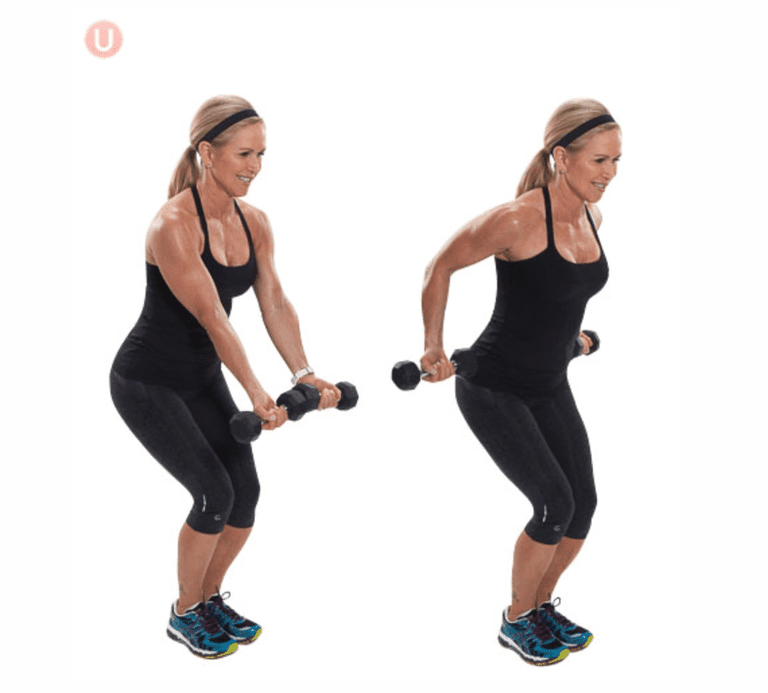
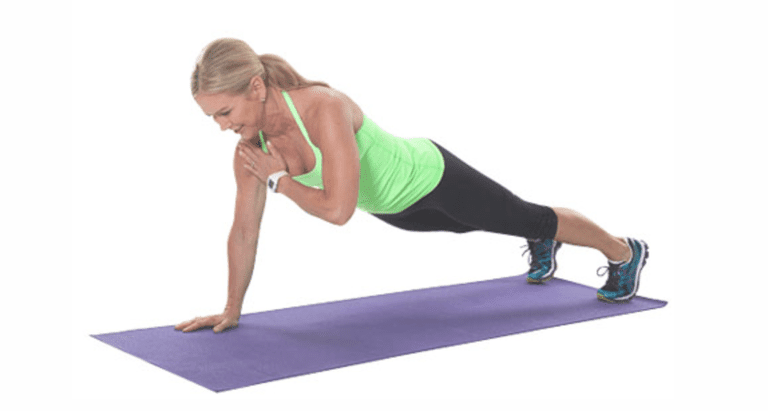
So pick up those weights—those HEAVY weights—and let’s get started. The following workout covers all upper body muscles and takes you through something called “supersets.” It means you will work two different exercises in a row for the same muscle group. This will push you more swiftly to the results you are looking for! How do you know what size dumbbells to choose? Remember, if you perform 12-15 repetitions and could keep going for more, your weights are too light. However, if you can’t even get to 8 repetitions without muscle failure, the weights are too heavy. Choose something challenging but doable. Exercises pictured are the first exercise in the set; for photos for all exercises, simply click on their name to be shown a visual demonstration.
Screenshot Screenshot Original article and pictures take www.verywell.com site