Backbends aren't just for yoga class. This gentle move will stretch through your abs and chest as well as increase flexibility in your spine and shoulders.
Stand with your back about three feet away from the tree. Lift your arms above your head, gently look behind you, and reach for the trunk. You might need to step closer to the tree if you're having a hard time making contact with the tree. Walk your hands as far down as you want, pressing into the bark to help your hips and ribs move forward, stacking them over your feet. Stay here for 30 seconds, and then slowly stand up.
Original article and pictures take media1.popsugar-assets.com site
It’s a common misconception that stretching after a workout alleviates muscle soreness. It doesn’t. But what it actually does, according to a recent study in the Journal of Medicine and Science in Sports and Exercise, is make you stronger. An increased range of motion – best achieved through effective stretching – allows your muscles to lengthen, catalysing faster growth.
Do this 10-minute stretching routine, designed by celebrity PT Ramona Braganza, after every workout to speed up your strength gains, increase your agility and injury-proof your body.
1. Downward dog
Reps 2
Hold the pose for 10 breaths – or around one minute.
How to do it Begin on your hands and knees with your fingers spread wide and toes curled. Exhale as you lift your pelvis up and backwards, straightening your arms and legs to form a wide inverted ‘V’ position. Keep pressing into the ground with your hands while simultaneously reaching your pelvis up as far as you can. Feel the stretch in your calf muscles, hamstrings and your back as you take long slow breaths while raising and lowering your heels to the ground.
Why “This increases flexibility and range of motion in your hamstrings and hips, and relieves muscle tension in your lower back,” says Braganza.
2. Lunge
Reps 2 each leg
Hold the pose for 10 breaths – or around one minute. Repeat with both legs
How to do it From a standing position, step backwards with your right foot as far as feels comfortable, landing with your back leg straight, your weight on the ball of your foot, and your front knee slightly bent. Keep your hips forward as you press your heel back towards the ground while lifting your pubic bone. Feel the stretch in your quads and hip flexors. Repeat with the other leg.
Why This improves your balance – often overlooked in a workout program. Also, holding in the pose will help strengthen and correct any muscle imbalances, says Braganza.
3. Triangle
Reps 2
Hold the pose for 10 breaths – or around one minute. Repeat with both sides
How to do it Begin standing with your legs around 3-4 feet apart, body facing forward, and arms stretched to make a capital ‘T’ at shoulder level. Turn your right foot out while keeping your hips facing forward and turn your left foot in from 90 degrees to 70 degrees. Make sure your base is strong by lining up your right heel with the instep of your left foot.
As you exhale, reach your right arm past your right toes, then slowly begin to bend to your right, pushing out from the hips and taking your right arm to a comfortable position on your leg, with your left arm continuing to reach up towards the ceiling. Do not roll your hips or torso forward. As you hold the pose, slowly allow your supporting hand to move further down your leg. Keep your head facing forward – or to make it more challenging look up at your left arm. Repeat on the other side.
Why This move is tough. It will increase tax your core, as well as improve your flexibility and balance. “The isometric contractions that this pose forces are a nice change-up from machine-based resistance workouts,” says Braganza.
Original article and pictures take www.menshealth.co.uk site
Best Pre- and Post-Workout Snacks for Any Type of Exercise
It's important to nourish your body when you ask a lot of it. Prepare for your next workout by eating a great pre-workout snack and then reward it for its hard work afterwards. We've found the best foods to eat before and after your favorite workouts to help you get the most them.
1. YOGA
Before: Yoga instructors recommend avoiding eating a large meal before yoga class. Trying to flow through poses is harder on a full stomach. Try eating a banana, apple or a small handful of nuts an hour before your yoga practice to give you energy and hold you over until you've finished.
After: Once you've finished yoga, treat your muscles with some protein. If it's a morning yoga class, an omelet with spinach is a great meal. For an evening class, prepare some salmon with a side of veggies.
2. RUNNING
Before: Before hitting the pavement (or treadmill) you'll want to fuel up! Runner's World suggests a snack that is higher in carbs but low in fiber and fat. Try some graham crackers with honey, a peanut butter and banana sandwich or some low-fat yogurt with fruit!
After: After running, make sure you get some water and electrolytes. After you've cooled down, giving your body some carbs and protein is a great idea. Try a tasty quinoa salad, chicken breast or a turkey sandwich!
3. LIFTING
Before: Going to a workout hungry means your muscles have nothing to build on. Before lifting weights, try to consume a snack with protein and carbs to give your body the fuel it needs. A salad is a great low-cal meal, but won't help you when you lifting!
After: Post-lifting, the obvious answer is to eat protein so you can sustain the muscle you're building. However, before you blend together a delicious Brownie Batter Protein Smoothie, add a little carb to your diet to get your insulin up. A piece of fruit should do the trick!
4. CARDIO
Before: When you pack your gym bag before Zumba, try grabbing an apple! A small dose of carbs will give your body the energy it needs. If you're going for a longer cardio workout, a bit of protein, like an egg or a small piece of meat, is a good idea, but give yourself a little over an hour to digest it.
After: According to Shape, if you've just completed a typical cardio workout, you don't necessarily need to eat right after because you've been burning calories thanks to an accelerated heart rate, but haven't used up much fuel. However, if you had a long workout, like when training for a race, or did a HIIT, high intensity workout or a lot of sprints, eating a snack with carbs and protein is a good idea.
(Photo: Shutterstock.com) (Photo: Shutterstock.com) (Photo: Shutterstock.com) (Photo: Shutterstock.com) (Photo: Shutterstock.com) (Photo: Shutterstock.com) (Photo: Shutterstock.com) (Photo: Shutterstock.com) (Photo: Shutterstock.com) (Photo: Shutterstock.com) Original article and pictures take asset.popculture.com site
Best Injury-Preventing Exercises Best Exercises to Prevent Injury
As anyone whose hobby involves physical activity knows, you can't expect your body to operate in tip-top shape without a little coaxing. Only running or cycling, for example, makes you more prone to painful injuries that can leave you nursing your condition on the couch instead of out there doing what you love. We've rounded up the best stretches and exercises to help you prehab before catastrophe happens. Pick a few from each common injury group to help stay out of the doctor's office and happily in the gym or on the road.
— Additional reporting by Lizzie Fuhr and Jenny Sugar
Original article and pictures take media1.popsugar-assets.com site
At Home WorkOUT - STRETCH!- Christian Fitness- Faith
Because Revelation Wellness is a ministry about complete wholeness we would be remiss not to remind you that flexibility is a necessity. I personally have 3x a week Holy Yoga practice that has changed my life. As much as we go, go , go we have got to whoa, whoa, whoa. Practically speaking, flexibility training is key to maintaining longevity in exercise. As much as we take from our body, we have got to give back. Stretching time allows for a more peaceful, quiet and centered time to hear from the Lord. For me this time is priceless.
Tag this cool workout on to the end of your "hot n spicy" Revelation Fitness training.
Original article and pictures take s.ytimg.com site
Upgrade your workout routine with these 10 leg exercises for women. Work your thighs, hips, quads, hamstrings, and calves at home to build shapely legs and get the lean and strong lower body you’ve always wanted!
Repeat this circuit 3 times and rest for 60 seconds between sets.
1. High knees: 60 seconds. Bring your knees up to waist level and then slowly land on the balls of your feet.
2. Curtsy lunge: 30 seconds + 30 seconds. Keep your weight on your right foot, take a big step back with your left leg and cross it behind your right leg. Bend the knees until your right thigh is parallel to the floor and then return to the starting position. Keep your toes pointing in the same direction as your knees.
3. Inner thigh lifts: 30 seconds + 30 seconds. Lie on your side, cross your top leg over and lengthen your bottom leg. Flex your bottom foot and press that leg up and down for 30 seconds.
4. Squat jacks: 45 seconds. Jump up, spread your feet, bend your knees and press your hips back. Push through the heels to jump back up and return to the starting position.
5. Bear squat: 45 seconds. Get down on your hands and knees, straighten your legs and lift your hips up toward the ceiling. Return to the initial position and repeat.
6. Bulgarian split squat: 30 seconds + 30 seconds. Place a step or a box behind you and stand up tall. Place your right foot on top of the step, bend your knees and lower the hips until your left thigh is parallel to the floor. Return to the starting position, repeat for 30 seconds and switch legs.
7. Skaters: 45 seconds. Lean forward with your back flat, jump to the right, bring your left foot behind you and bring your left arm in front of you. Jump to the left and bring your right arm in front of you and your right foot behind you. Repeat for 45 seconds.
8. Plie squat calf raise: 45 seconds. Start in a sumo squat position, with your feet in a wide stance, your toes pointing out to the sides and your thighs parallel to the floor. Raise your heels off the floor and squeeze your calves. Lower your heels and repeat.
9. Single leg bridge: 30 seconds + 30 seconds. Lie on your back with your arms by your sides, knees bent and feet flat on the floor. Raise one leg and lift your hips as high as you can. Lower your hips, repeat for 30 seconds and switch legs.
10. Wall sit: 45 seconds. Stand with your back pressed against a wall, your knees bent and your thighs parallel to the floor. Hold this position for 45 seconds.
What you eat is important. However, when you eat it can be just as critical.
What is post-workout nutrition?
Post-workout nutrition is an intriguing topic and rightfully so. The basic idea is threefold:
The body deals with nutrients differently at different times, depending on activity.
What you consume before, during, and especially after your workout is important.
By consuming particular nutrients after your workouts (aka post-workout nutrition), you improve your body composition, performance, and overall recovery.
Numerous studies have examined everything from the composition of the carbohydrate in post-workout drinks to exact amino acid combinations. Studies continue to reveal effective post-workout nutrition strategies for athletes and recreational exercisers of all types.
Generally, post-workout nutrition has three specific purposes:
Replenish glycogen
Decrease protein breakdown
Increase protein synthesis
In other words, athletes/exercisers want to:
replenish their energy stores
increase muscle size and/or muscle quality
repair any damage caused by the workout
In doing so, they want to increase performance, improve their appearance, and enable their bodies to remain injury-free.
Proposed benefits of good post-workout nutrition include:
Improved recovery
Less muscle soreness
Increased ability to build muscle
Improved immune function
Improved bone mass
Improved ability to utilize body fat
These benefits seem to work for everyone, regardless of gender or age.
Why are workout and post-workout nutrition so important?
When we work out intensely, we damage tissues at the microlevel, and we use fuel.
This is what ultimately makes us stronger, leaner, fitter, and more muscular, but in the short term it requires repair.
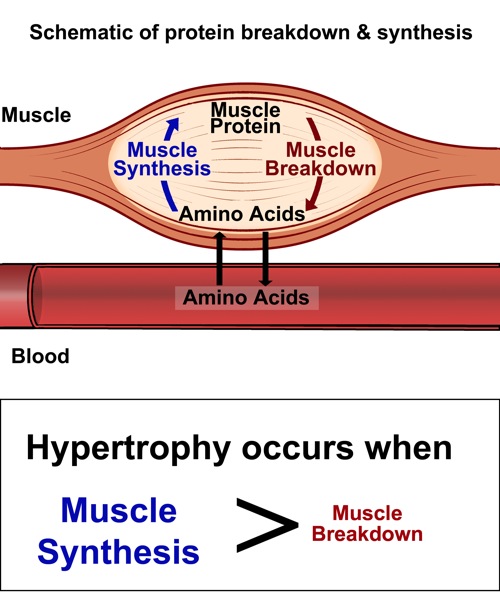
Repair and rebuilding occurs through the breakdown of old, damaged proteins (aka protein breakdown) and the construction of new ones (aka protein synthesis) — a process known collectively as protein turnover.
Muscle protein synthesis is increased slightly (or unchanged) after resistance workouts, while protein breakdown increases dramatically. We’re doing a lot more breaking-down than building-up.
The relationship between these two parameters (rate of muscle protein synthesis and muscle protein breakdown) represents the metabolic basis for muscle growth.
Muscle hypertrophy occurs when a positive protein balance can be established during recovery — in other words, when we make sure we have enough raw materials available for protein synthesis to occur, so that it doesn’t lag behind protein breakdown.
This is especially difficult with endurance athletes as protein synthesis drops and protein breakdown goes up.
Protein breakdown and synthesis
Studies show that this trend can be reversed – specifically, protein synthesis is stimulated and protein breakdown is suppressed when you consume the right type of nutrients after exercise.
Protein is not the only concern, however. During exercise sessions, stored carbohydrates can be substantially depleted.
Thus, during the postworkout period, we require protein and carbohydrates.
The raw materials we give our body through the consumption of food/supplements in the workout and post-workout periods are critical to creating the metabolic environment we desire.
What you should know about workout nutrition
Availability
Availability strongly influences the amino acid/glucose delivery and transport.
In other words, in order for our bodies to use raw materials to rebuild and recover, those raw materials have to be available. And if they’re available, then our body is more likely to use them. Simply having the materials around can signal to our body that it’s time to rebuild.
We improve availability in two ways.
Increased blood flow to skeletal muscle during and after exercise means that more nutrients are floating around more quickly.
Providing an amino acid and glucose dense blood supply during and after exercise means that the rate of protein synthesis goes up.
Thus, we improve availability by having more blood circulating more rapidly, and by having more nutrients in that blood.
The “window of opportunity”
Some refer to this workout and post-workout phenomenon as “the window of opportunity”.
During this window, your muscles are primed to accept nutrients that can stimulate muscle repair, muscle growth, and muscle strength.
This window opens immediately after your workout and starts to close pretty quickly. Research suggests that while protein synthesis persists for at least 48 hours after exercise, it’s most important to get postworkout nutrition immediately, and within 2 hours afterwards.
If you feed your body properly while this window is open, you’ll get the benefits.
If you don’t provide adequate post exercise nutrition fast enough — even if you delay by only a couple of hours — you decrease muscle glycogen storage and protein synthesis.
As soon as you drop that last dumbbell, you should be consuming some postworkout nutrition.
What to eat
As we’ve mentioned, post-workout nutrition requires two things:
Protein to aid in protein synthesis
Carbohydrates to help replace muscle glycogen (and to enhance the role of insulin in transporting nutrients into cells)
You could certainly eat a whole food meal that meets these requirements after exercise.
However, whole food meals aren’t always practical.
Some people aren’t hungry immediately after exercise.
Whole food digests slowly, and we want nutrients to be available quickly.
A whole food meal that requires refrigeration might be less practical.
On the other hand, consuming a liquid form of nutrition that contains rapidly digesting carbohydrates (e.g., maltodextrin, dextrose, glucose, etc) and proteins (e.g., protein hydrolysates or isolates:
might accelerate recovery by utilizing insulin for nutrient transport into cells;
can result in rapid digestion and absorption; and
is often better tolerated during and after workouts.
Combining protein and carbohydrates might aid recovery
Data indicate that it may only take about 20 grams of protein after a workout to maximally stimulate muscle protein synthesis.
Which workouts qualify?
Save your workout drink for weight training, interval, and endurance training lasting 45 minutes or longer.
Casual exercise like walking the dog, moving cobblestones for grandpa, or riding your bike to the arcade doesn’t require a recovery drink.
When performing energy expenditure work to burn energy or lose fat, a recovery drink is not necessary. If you’re prioritizing fat loss, performance and recovery from these sessions are not as important as creating an energy deficit.
Still, if overall energy intake is low from food intake, and lots of time is being spent performing energy expenditure work, consuming a branched chain amino acid (BCAA) supplement might be helpful.
Summary and recommendations
With intense workouts/training, start by ingesting 30 grams of carbohydrate and 15 grams of protein (in 500 ml water) per hour of workout time.
You can sip this during the workout or consume it immediately after.
You can either make your own post-workout drink or find a pre-formulated drink that contains rapidly digesting carbohydrates (e.g., maltodextrin, dextrose, glucose, etc) and proteins (e.g., protein hydrolysates or isolates).
Once your workout is complete, have a whole food meal within an hour or two.
If priority #1 is to lose body fat, use only BCAAs as a workout drink. About 5 to 15 grams per hour of training (200 pounds or more = closer to 15 grams, 200 pounds or less = closer to 5 grams).
If you’re leaner but still want to lose fat, choose a smaller dose (like 1/2 dose) of the protein + carb combination, or opt for BCAAs.
For extra credit
The combination of carbohydrate and amino acids during/after exercise creates a stimulatory effect of growth hormone and testosterone that doesn’t happen during the rest of the day. In other words, if you just drink a carb + protein drink while sitting on the couch, it won’t have the same effect.
When choosing carbohydrates, keep in mind that glucose is absorbed faster than fructose, and solutions high in fructose have been linked to gastrointestinal distress, greater fatigue, and higher cortisol levels.
It may be helpful to add creatine to your workout nutrition.
Essential amino acids may be more important than nonessential for promoting positive nitrogen balance after workouts.
Eat, move, and live… better.
The health and fitness world can sometimes be a confusing place. But it doesn’t have to be.